Server Racks in the Garage: Inside America's Quiet Obsession with Used Dell PowerEdge Machines
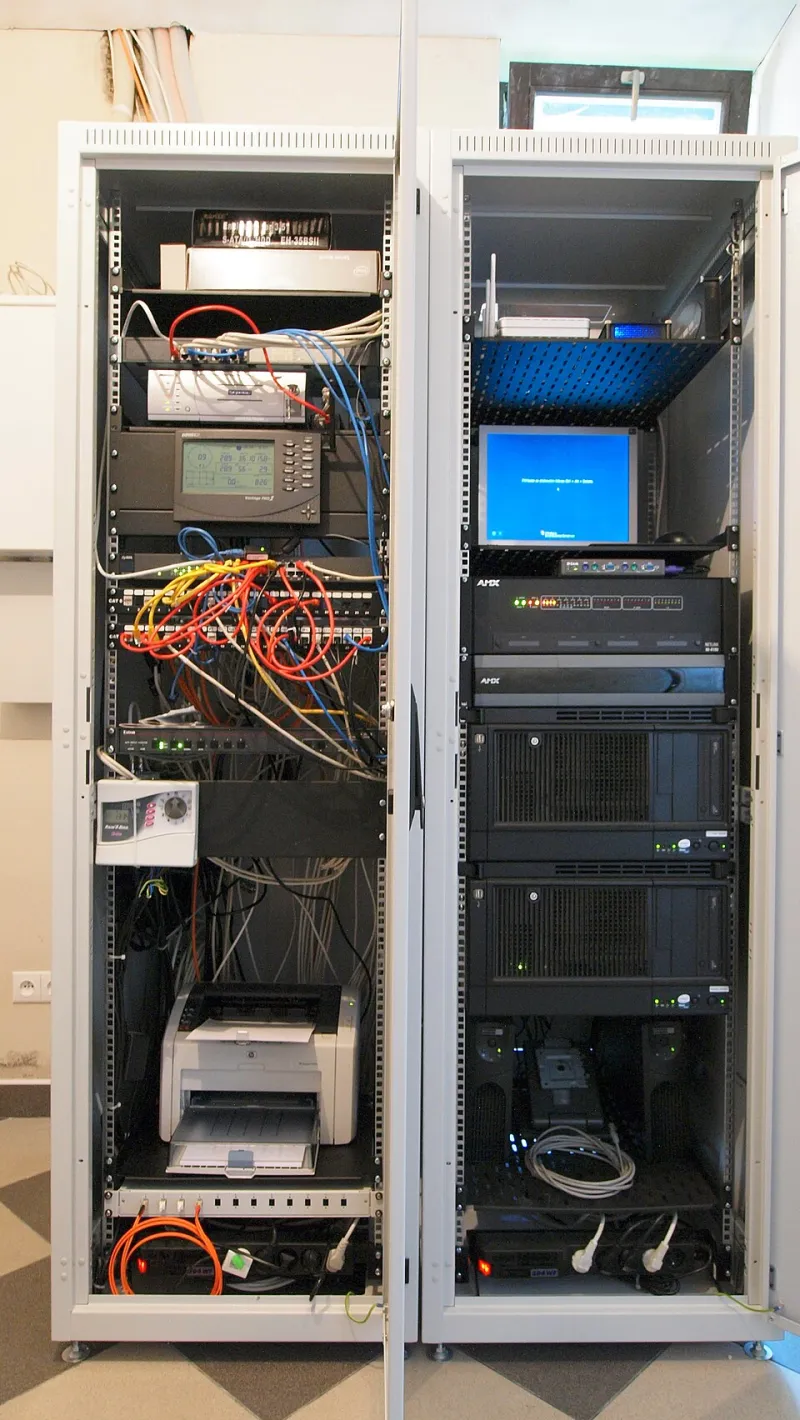
Photo: Jan Prucha, CC BY-SA 3.0, via Wikimedia Commons
At 11 p.m. on a Tuesday in suburban Ohio, Marcus Feldman's garage hums at roughly 62 decibels. Inside a repurposed server rack sits a Dell PowerEdge R730, a machine Dell originally shipped to a Fortune 500 data center nearly a decade ago. Today it streams his family's movie library, backs up every photo on three relatives' phones, and hosts a small website for his wife's bakery.
"The IT department that bought this thing paid eight thousand dollars," Feldman says. "I paid two hundred eighty with the rails included."
He is not alone. The American home lab movement — a loose federation of self-hosting enthusiasts, tinkerers, and privacy-minded hobbyists — has turned the secondary market for used Dell enterprise gear into something resembling a cottage industry. On Reddit's r/homelab, Discord servers, and YouTube channels devoted to rack builds, the PowerEdge line shows up again and again, and not by accident.
Why Dell Gear Keeps Winning the Used Market
Several factors converge in Dell's favor. First, sheer volume: as one of the largest enterprise server vendors in the world, Dell has flooded the secondary market with decommissioned units. When a corporation refreshes its data center, hundreds of identical machines hit the resale channels at once, driving prices down.
Second, documentation. Dell's support pages, service manuals, and part databases remain publicly accessible even for long-discontinued models, which matters enormously to hobbyists troubleshooting at midnight. Third, parts availability. A failed power supply or fan module for a PowerEdge R720 can often be had for under twenty dollars shipped.
"It's the Honda Civic of servers," says Dana Whitfield, a network engineer in Austin who runs a three-node cluster in her home office. "Boring in the best way. Everything is documented, everything is replaceable, and there are a million other people who've hit the same problem before you."
The Power Bill Reality Check
Enthusiasm cools somewhat when the electric bill arrives. Older PowerEdge units draw meaningful standby power even when idle — a loaded R730 can pull 150 watts or more doing nothing. At the national average of roughly 17 cents per kilowatt-hour, that's around $220 a year before the machine does any real work.
Whitfield's advice to newcomers is blunt: "Do the math on electricity before you do the math on the purchase. A five-year-old machine that costs $150 less but burns $200 more per year in power is not a deal."
This is why the conversation in home lab circles has shifted across generations. The R710, once the community darling, has largely been retired by anyone paying their own utilities. The R730 remains popular for its balance of price and efficiency, while newer R640 and R740 units — now appearing under $500 — offer dramatically better idle consumption thanks to their Xeon Scalable processors.
What the Builders Actually Run
Ask ten home labbers what their servers do and you'll get eleven answers. Common workloads include:
- Media servers. Plex and Jellyfin remain the gateway drug. A single PowerEdge can transcode multiple simultaneous 4K streams.
- Network-attached storage. TrueNAS and similar platforms turn old servers into personal cloud replacements, a trend accelerated by recurring subscription fatigue.
- Home automation. Self-hosted Home Assistant installations controlling lighting, security, and climate.
- Local AI models. A newer development: hobbyists running quantized language models on-premises, though most concede that consumer GPUs in a desktop case outperform server-class hardware for inference.
- Learning. Perhaps the most common workload of all — practicing for certifications on real virtualization platforms without risking an employer's infrastructure.
"I got my first job in IT because of my home lab," Feldman says. "The interview was basically me showing them my Proxmox cluster."
A Newcomer's Buying Guide
For those tempted to join, the community consensus on value breaks down fairly cleanly. The R730 hits the sweet spot for a first serious build: dual-socket capability, 128GB-plus memory support, and a deep secondhand market, typically $200 to $400 depending on configuration. The R630 suits those prioritizing a smaller footprint in a two-socket package. Buyers wanting the quietest possible operation should look at tower models like the T620 or T630, which sacrifice rack density for tolerable noise levels in a home environment.
Whatever the model, veterans recommend verifying drive caddies are included — they're cheap individually but add up — and confirming the unit ships with its iDRAC enterprise license, Dell's remote management card that turns a garage server into something remotely administerable.
More Than a Hobby
There's a quiet ideology underneath all this. In an era when consumer technology increasingly means recurring subscriptions and opaque cloud dependencies, the home lab represents a small act of sovereignty. Your movies live on your drives. Your files answer to no terms of service.
Whitfield puts it simply: "Somebody bought these machines to run a company. Now they run my household. There's something satisfying about that."
Somewhere in Ohio, a server that once processed invoices for a corporation nobody remembers is now keeping a bakery's website online. That, more than any spec sheet, explains the movement.